

7 Common Mistakes Businesses Make When Implementing AI in Customer Service (And How to Avoid Them)
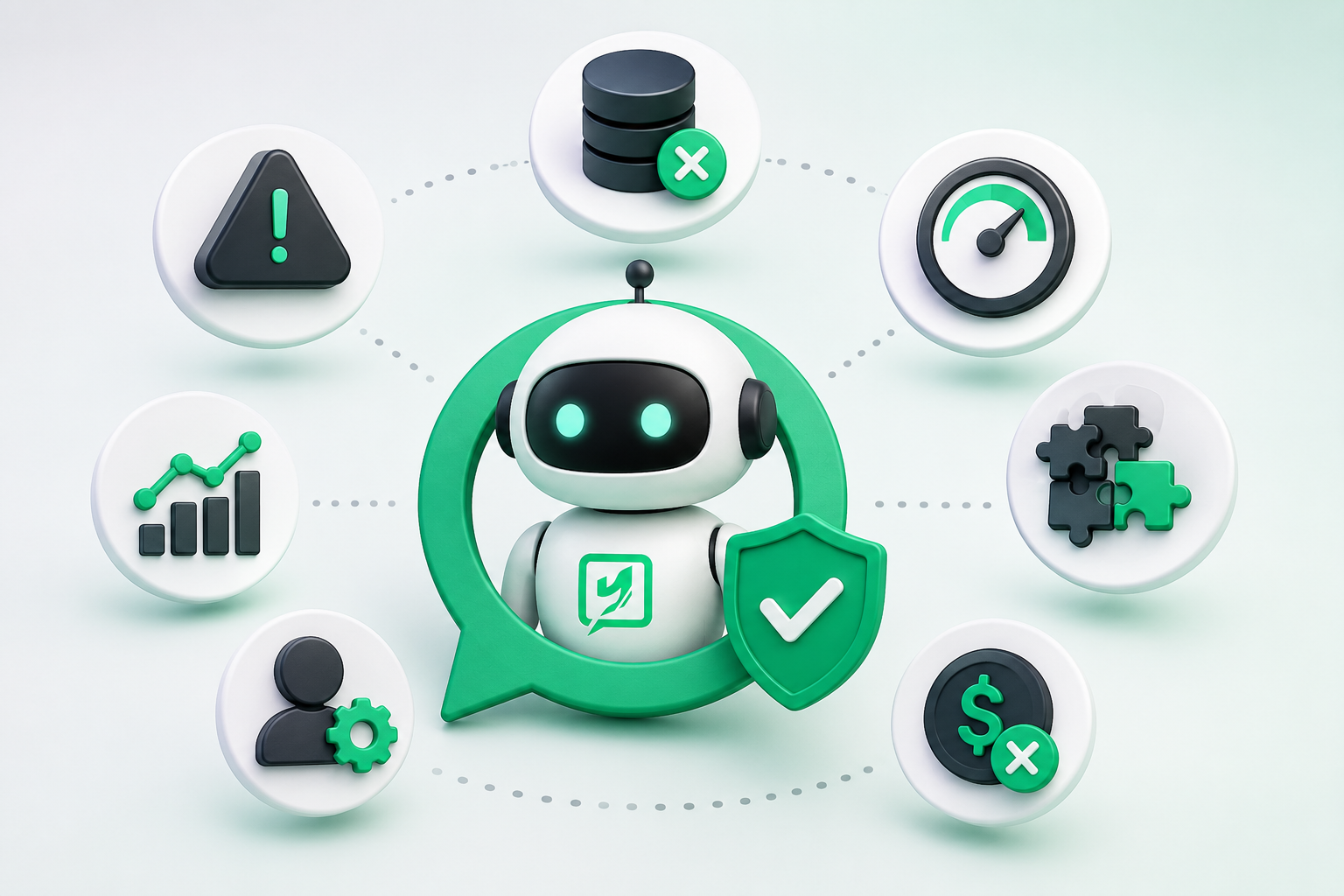
Artificial Intelligence (AI) has become an essential part of digital transformation strategies across industries, especially in customer service. It enables businesses to automate repetitive tasks, improve response times, enhance operational efficiency, and deliver better customer experiences.
However, successfully implementing AI is not just about choosing the right technology. It also depends on how that technology is integrated into business operations and customer service processes.
Many organizations make common mistakes during AI adoption that can reduce customer satisfaction, limit the return on investment, and in some cases create a poorer customer experience than traditional support methods.
In this article, we'll explore the most common mistakes businesses make when implementing AI in customer service and share practical recommendations to help organizations maximize the value of their AI initiatives.
Mistake #1: Relying Entirely on Artificial Intelligence
One of the most common misconceptions is believing that AI can completely replace human customer service representatives. Although AI technology has advanced significantly in recent years, there are still many situations that require human judgment, emotional intelligence, and problem-solving skills.
Customers don't always need a fast answer—they sometimes need empathy, negotiation, personalized support, or assistance with complex issues that AI alone cannot effectively handle.
For this reason, businesses should view AI as a tool that empowers customer service teams rather than replacing them. When AI and human employees work together, organizations can achieve the ideal balance between efficiency, speed, and customer satisfaction.
Mistake #2: Using Outdated or Inaccurate Data
Artificial intelligence is only as effective as the information it relies on. If AI systems are trained using outdated, incomplete, or inaccurate data, they are likely to provide incorrect answers that reduce customer trust and negatively impact the overall customer experience.
To avoid this issue, businesses should regularly review and update their knowledge bases, pricing information, company policies, services, and frequently asked questions. Keeping information accurate and current allows AI assistants to provide reliable responses that customers can trust.
Mistake #3: Ignoring the Customer Experience
Some organizations focus primarily on reducing operational costs and overlook the main purpose of AI: improving the customer experience. When conversations become overly complicated, customers struggle to reach a human representative, or AI repeatedly provides unhelpful responses, the customer experience quickly deteriorates regardless of how advanced the technology may be.
Instead, businesses should design customer journeys that are simple, intuitive, and customer-focused while always providing a seamless option to transfer customers to a live agent whenever human assistance is needed.
Mistake #4: Failing to Measure AI Performance
Some businesses assume that implementing AI is the final step in their digital transformation journey. In reality, deployment is only the beginning. Without continuously monitoring performance and analyzing results, it becomes difficult to determine whether AI is delivering the expected value or whether improvements are needed.
Businesses should regularly track key performance indicators (KPIs), including average response time, First Contact Resolution (FCR), Customer Satisfaction (CSAT), the number of inquiries resolved automatically, and the escalation rate to human agents.
Monitoring these metrics allows organizations to identify areas for improvement, measure return on investment (ROI), and continuously optimize customer service performance.
Mistake #5: Failing to Integrate AI with Other Business Systems
Artificial intelligence delivers its greatest value when it becomes part of a connected business ecosystem rather than operating as an isolated tool. When AI solutions are not integrated with Customer Relationship Management (CRM) systems, Enterprise Resource Planning (ERP) platforms, or internal databases, employees often need to switch between multiple systems and manually enter customer information.
This increases operational complexity, slows response times, and raises the likelihood of human error. By integrating AI with existing business systems, organizations can automatically access customer information, synchronize data, streamline workflows, and provide faster, more personalized customer experiences.
For this reason, system integration should be one of the most important considerations when selecting an AI solution.
Mistake #6: Neglecting Employee Training
Even the most advanced AI solution cannot deliver its full value if employees are not properly trained to use it. Artificial intelligence should be viewed as a productivity tool that supports employees rather than replacing them.
Organizations should ensure that customer service teams understand the system's capabilities, know when human intervention is required, and are familiar with best practices for working alongside AI. Employee feedback is equally valuable. Since support teams interact directly with customers every day, they can provide practical insights that help improve AI performance and enhance the overall customer experience.
Mistake #7: Choosing the Cheapest Solution Instead of the Right One
When evaluating AI solutions, some businesses focus primarily on price rather than long-term value. Although lower-cost solutions may appear attractive initially, they often lack essential capabilities such as advanced analytics, workflow automation, system integrations, scalability, or enterprise-grade security.
As business needs grow, organizations frequently discover that these limitations require them to replace the solution entirely, resulting in higher costs over time. Instead of selecting a platform based solely on price, businesses should evaluate how well the solution supports long-term growth, improves customer experience, increases operational efficiency, and adapts to future business requirements.
How Yafe Helps Businesses Avoid These Mistakes
Successfully implementing AI starts with choosing a platform that goes beyond automation and supports the entire customer service ecosystem. Yafe provides an integrated suite of AI-powered communication solutions designed to help businesses implement artificial intelligence effectively while maintaining the perfect balance between automation and human interaction.
Yafe's platform includes AI Chatbots for intelligent customer conversations, AI Callbots for handling customer calls automatically, workflow automation to eliminate repetitive manual tasks, smart WhatsApp marketing campaigns, direct payment within WhatsApp conversations, integration with CRM, ERP, and internal business systems, and advanced analytics and reporting dashboards to monitor performance and support data-driven decision-making.
With all these capabilities available in one platform, businesses can improve response times, reduce manual workloads, streamline operations, and deliver exceptional customer experiences while keeping operational costs under control.
Conclusion
Artificial intelligence offers tremendous opportunities to transform customer service, but success depends not only on the technology itself—it also depends on how organizations implement it. By avoiding common mistakes such as relying entirely on AI, using outdated data, neglecting employee training, failing to measure performance, or choosing solutions based solely on price, businesses can unlock the full potential of AI while delivering a superior customer experience.
As AI continues to evolve, organizations that adopt scalable, well-integrated, and customer-focused solutions will be better positioned to improve operational efficiency, strengthen customer relationships, and maintain a competitive advantage in an increasingly digital marketplace.
Frequently Asked Questions (FAQ)
Can AI manage customer service entirely on its own?
No. AI is designed to automate repetitive tasks and improve efficiency, while human agents continue to play a critical role in handling complex situations, providing empathy, and making informed decisions.
What are the most common mistakes businesses make when implementing AI?
The most common mistakes include relying entirely on AI, using outdated or inaccurate data, neglecting customer experience, failing to measure performance, not integrating AI with business systems, overlooking employee training, and choosing solutions based only on price.
Is AI suitable for businesses of all sizes?
Yes. Organizations of all sizes can benefit from AI-powered customer service solutions. Many businesses start by automating common inquiries and gradually expand to additional communication channels and business processes.
How can businesses measure the success of AI implementation?
Success can be measured using key performance indicators (KPIs) such as response time, First Contact Resolution (FCR), Customer Satisfaction (CSAT), automation rate, escalation rate, and overall return on investment (ROI).
Why is system integration important for AI solutions?
Integrating AI with CRM, ERP, and other business systems enables organizations to automate workflows, reduce manual work, improve data accuracy, and deliver faster, more personalized customer experiences.
Ready to Implement AI the Right Way?
Successfully adopting artificial intelligence is about more than choosing the right technology—it's about implementing solutions that support your business goals while enhancing the customer experience.
If you're looking for an all-in-one platform that combines AI Chatbots, AI Callbots, workflow automation, WhatsApp marketing campaigns, direct payment within WhatsApp conversations, and seamless integrations with your existing business systems, Yafe provides everything your business needs to deliver smarter, faster, and more efficient customer interactions.