

How AI Reduces Customer Service Costs Without Compromising Customer Experience
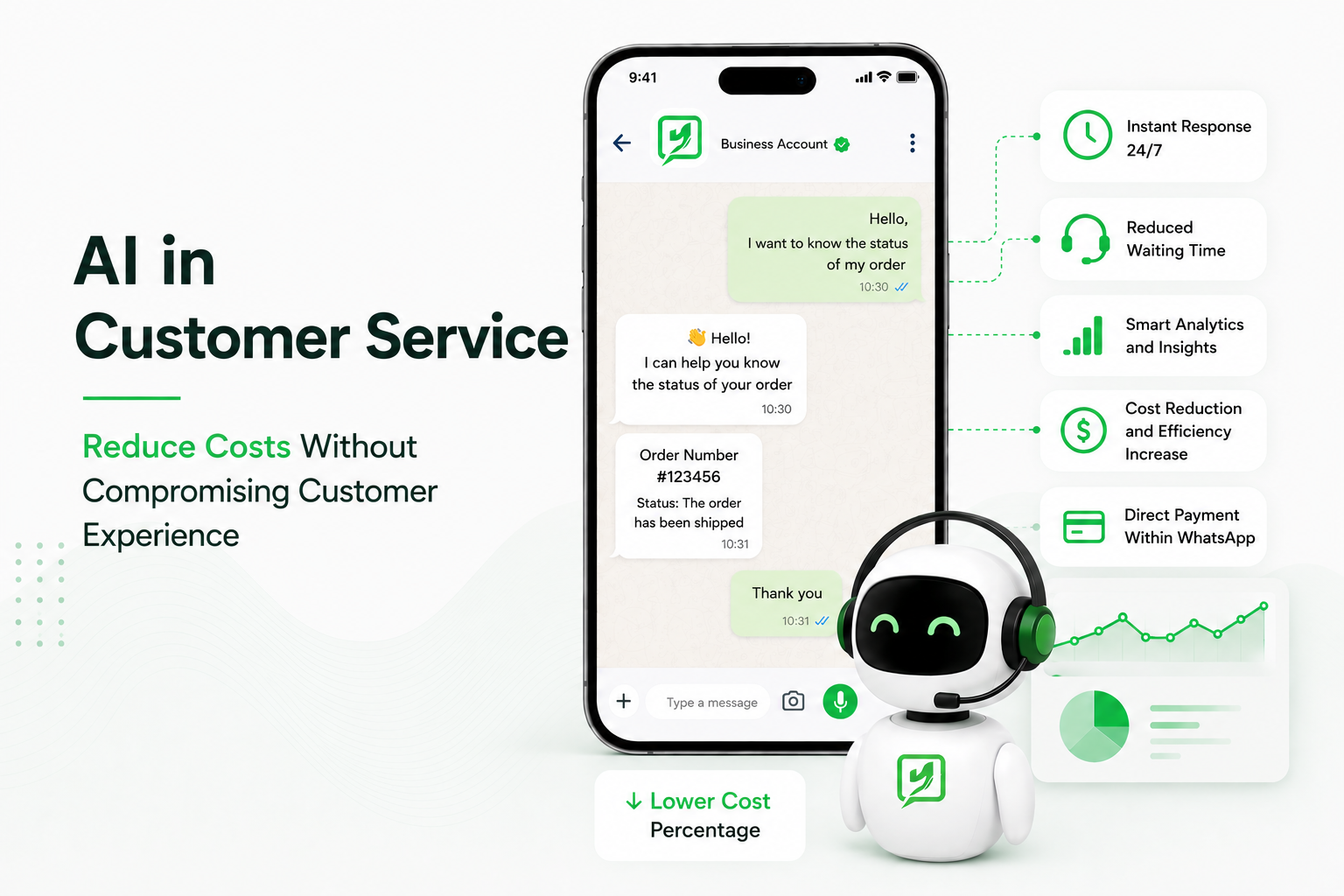
In today's highly competitive business landscape, customer service has become one of the most important factors influencing a company's success and long-term growth. Customers expect fast responses, seamless interactions, and consistent support across multiple communication channels, whether through WhatsApp, phone calls, email, or live chat.
At the same time, businesses face the ongoing challenge of delivering exceptional customer service while controlling operational expenses. As customer inquiries continue to grow, organizations often need to hire additional support agents, invest in continuous training, and manage larger customer service teams—all of which increase operational costs.
This is where Artificial Intelligence (AI) is transforming customer service. Rather than replacing human employees, AI empowers them by handling repetitive and time-consuming tasks, allowing support teams to focus on complex customer issues that require human judgment and expertise.
By integrating AI-powered customer service solutions, businesses can improve response times, increase operational efficiency, enhance customer satisfaction, and significantly reduce operating costs without compromising the overall customer experience.
In this article, we'll explore the key ways AI helps organizations optimize customer service while maintaining high-quality customer interactions.
1. Automating Repetitive Customer Inquiries
A significant percentage of customer inquiries are repetitive in nature. Customers frequently ask questions such as: What are your business hours? Where is my order? How can I make a payment? What is your return policy? How can I contact technical support? Although these questions are relatively simple, they consume a considerable amount of your customer service team's time.
AI-powered Chatbots and AI Callbots can automatically answer these repetitive inquiries 24/7 without requiring human intervention.
For example, instead of asking a customer to wait several minutes to check an order status, an AI assistant can instantly retrieve the information and provide an accurate response within seconds.
This not only creates a faster and smoother customer experience but also reduces the workload on customer service representatives, enabling businesses to scale their operations without continuously increasing headcount.
2. Reducing Response Times and Improving Customer Satisfaction
Response time is one of the most important metrics customers use to evaluate service quality. Even a short delay in responding to customer inquiries can negatively impact satisfaction and may encourage customers to seek alternatives from competitors.
AI significantly improves response times by instantly answering common questions and directing customers to the appropriate service without unnecessary waiting or multiple transfers.
Unlike human agents, AI systems can simultaneously manage thousands of conversations and phone calls, ensuring consistent service regardless of demand. This allows customer support teams to focus their efforts on more complex issues while AI efficiently handles routine requests.
The result is a more productive support operation, lower operational costs, and a significantly improved customer experience.
3. Smart Customer Routing
One of the biggest challenges businesses face is ensuring that customers reach the right department as quickly as possible. When customers are transferred between multiple teams before finding the right person, response times increase, operational costs rise, and customer satisfaction declines.
Artificial intelligence addresses this challenge by identifying the customer's intent from the very beginning of the conversation or phone call. Based on the request, AI can automatically direct the customer to the appropriate department or specialist without unnecessary transfers.
For example, if a customer is asking about an invoice, the system can immediately route the inquiry to the finance team. If the issue is technical, the request is directed to technical support. Sales inquiries can be sent directly to the sales team, all without requiring manual intervention.
This intelligent routing shortens resolution times, improves operational efficiency, and creates a smoother customer experience while reducing the workload on support teams.
4. Increasing Customer Service Team Productivity
Artificial intelligence is not designed to replace customer service professionals—it is designed to make them more productive. Customer service representatives often spend a significant portion of their day performing repetitive administrative tasks, such as searching for customer information, writing similar responses, documenting conversations, and updating internal systems.
AI-powered tools automate many of these activities by summarizing customer conversations automatically, suggesting relevant responses based on the conversation context, retrieving customer information instantly, creating support tickets automatically, and updating customer records without manual data entry.
By reducing the time spent on repetitive work, customer service teams can dedicate more attention to complex issues that require human expertise, empathy, and decision-making. As a result, businesses can improve productivity without continuously expanding their workforce, allowing them to serve more customers while keeping operational costs under control.
5. Reducing Human Errors and Improving Service Quality
Manual processes naturally increase the risk of human error, especially when customer service teams handle large volumes of requests every day. Errors such as entering incorrect information, routing customers to the wrong department, or providing inconsistent answers can lead to customer dissatisfaction, repeated work, additional operational costs, and even damage to a company's reputation.
Artificial intelligence helps minimize these risks by following predefined workflows and analyzing customer requests consistently. AI systems can verify information before completing actions, ensuring greater accuracy and reducing mistakes caused by workload pressure or repetitive tasks.
Another major advantage is consistency. AI delivers standardized responses based on approved business rules, ensuring that every customer receives the same level of service regardless of the communication channel or time of day.
Real-World Example
Imagine a company that receives more than 5,000 customer inquiries every month through WhatsApp and phone calls. If approximately 60% of those inquiries are repetitive, AI can automatically handle thousands of routine requests without requiring human intervention.
This allows customer service representatives to focus on high-value interactions such as resolving complex issues, assisting key customers, and handling situations that require critical thinking and personalized support.
The result is not only lower operating costs but also faster response times, shorter waiting periods, and a significantly better customer experience.
6. Providing 24/7 Customer Support Without Increasing Costs
Today's customers expect businesses to be available whenever they need assistance—not just during business hours. Whether it's late at night, over the weekend, or during public holidays, customers want quick answers and immediate support.
For businesses, providing round-the-clock customer service using only human agents can be expensive. It often requires hiring additional employees, managing multiple shifts, and increasing operational expenses.
Artificial intelligence offers a smarter alternative. AI-powered Chatbots and Callbots can handle customer inquiries 24 hours a day, seven days a week. They can answer common questions, provide updates, collect customer information, and perform various tasks without requiring human intervention.
When a request requires personal assistance, AI can seamlessly transfer the conversation to the appropriate employee while providing a complete summary of the interaction. This allows agents to continue the conversation without asking customers to repeat their information.
By combining AI with human expertise, businesses can provide continuous support while maintaining efficient operations and controlling costs.
7. Making Better Business Decisions with AI-Powered Analytics
Every customer interaction generates valuable data. From frequently asked questions and peak communication hours to response times and customer satisfaction levels, this information provides businesses with valuable insights into their customer service performance.
Artificial intelligence transforms this raw data into meaningful analytics that help organizations make smarter decisions. Interactive dashboards and AI-powered reports enable businesses to identify recurring customer issues, monitor service performance, measure operational efficiency, and uncover opportunities for improvement.
For example, if analytics reveal that a large number of customers repeatedly ask the same question, the company may decide to improve its FAQ section, simplify a business process, or automate that specific customer journey.
Organizations can also track key performance indicators (KPIs) such as response time, first-contact resolution, customer satisfaction, and conversation volume, allowing management teams to make data-driven decisions with greater confidence.
How Yafe Helps Businesses Achieve These Results
Yafe provides an integrated suite of AI-powered customer communication solutions designed to help businesses improve customer experience while increasing operational efficiency. These solutions include AI Chatbots for intelligent customer conversations, AI Callbots for handling customer calls automatically, workflow automation to eliminate repetitive manual tasks, smart WhatsApp marketing campaigns, direct payment within WhatsApp conversations, integration with CRM, ERP, and internal business systems, and advanced analytics and reporting dashboards that provide valuable operational insights.
By bringing all these capabilities together in a single platform, Yafe enables businesses to improve response times, reduce manual work, streamline customer interactions, and lower operational costs without compromising service quality.
Conclusion
Artificial intelligence is no longer a future technology—it has become an essential business tool for organizations looking to deliver exceptional customer service while operating more efficiently. By automating repetitive tasks, reducing response times, increasing employee productivity, and providing valuable business insights, AI enables companies to reduce customer service costs while maintaining a high-quality customer experience.
Businesses that embrace AI today will be better positioned to improve operational efficiency, strengthen customer relationships, and remain competitive in an increasingly digital marketplace.
Frequently Asked Questions (FAQ)
Does AI replace customer service employees?
No. AI is designed to support customer service teams by automating repetitive tasks, allowing employees to focus on complex cases that require human expertise, empathy, and decision-making.
Is AI suitable for small and medium-sized businesses?
Yes. Businesses of all sizes can benefit from AI-powered customer service solutions. Many organizations begin by automating common inquiries before expanding to additional communication channels and workflows.
Will AI negatively affect the customer experience?
When implemented correctly, AI enhances the customer experience by providing faster responses, reducing waiting times, and ensuring customers receive consistent support while still allowing seamless escalation to human agents whenever needed.
Ready to Transform Your Customer Service?
Investing in AI-powered customer service solutions enables businesses to improve customer experience, increase operational efficiency, and reduce costs in a sustainable way.
If you're looking for an integrated platform that combines AI Chatbots, AI Callbots, workflow automation, WhatsApp Business solutions, direct in-chat payments, and seamless system integrations, Yafe provides everything your business needs to build smarter, faster, and more efficient customer experiences.